The calendar gives every day the same size. Your memory does not.
Some weeks blur. Some afternoons stay with you for years. This asks how much of your recent time actually registered.
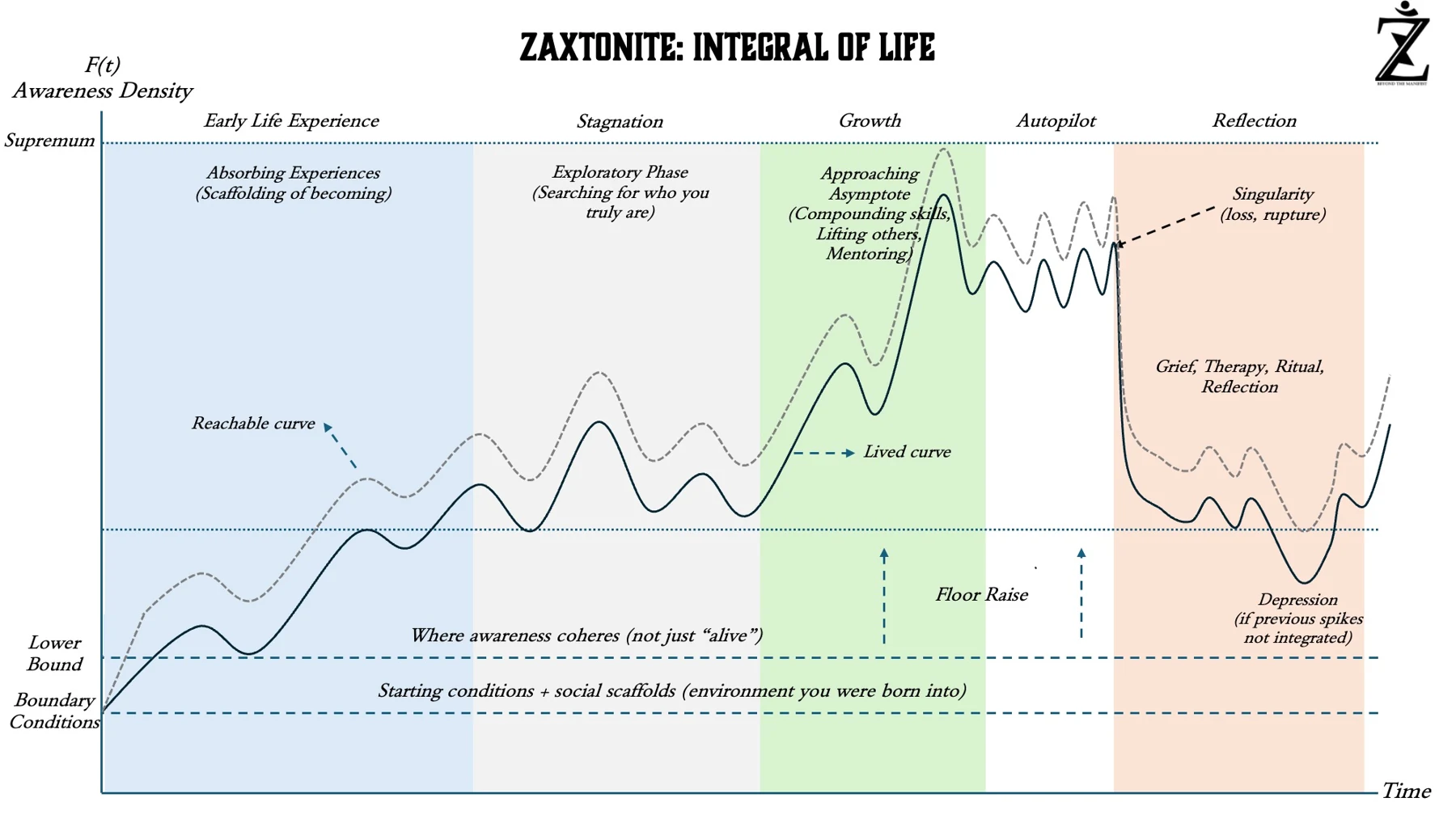
The Integral of Life framework. Tap to inspect it at full size.
Seven days
Do not rate your life. Just inspect the last seven days.
How many days left any real trace in you?
0 days4 days7 days
What raises the curve?
What makes a day register?
Pick up to three.
What flattens it?
What makes hours pass without leaving much behind?
Pick up to three.
Peaks, or a higher everyday floor?
For the next year, you can change only one thing.
The singularity
Is one old event still deciding the emotional weather of newer days?
You do not need to name it.
Where are you now?
Which sentence describes the last few months most accurately?
Tomorrow
Which change would touch the greatest number of ordinary hours?
What your answers drew
days that actually registered
where you are now
old event's pull
Integral of Life
The graph is not a score. It is only a way to see where time is becoming experience and where it is passing without much entering.
One terrible point does not own the whole curve. One spectacular peak cannot carry a life forever either. Most of the area comes from ordinary days because there are so many of them.
Look again. You can now see the floor, the rupture, and the stretches that registered compared with the stretches that mostly passed.